


Clean drinking water is essential for a healthy life, especially in cities where water quality can vary significantly. One of the most effective and widely used methods for water purification today is RO (Reverse Osmosis). But what exactly is RO water purification, and how does it work?
In this guide, we’ll break down everything you need to know in simple terms.
What is RO Water Purification?
RO (Reverse Osmosis) is a water purification process that removes impurities, contaminants, and dissolved salts from water using a semi-permeable membrane.
In simple words, RO systems filter out harmful substances like:
- Dirt and sediments
- Heavy metals (lead, arsenic)
- Dissolved salts (high TDS)
- Bacteria and viruses
- Chemicals like chlorine and pesticides
The result is clean, safe, and better-tasting drinking water.
Why is RO Water Purification Important?
In many parts of India, water contains high levels of TDS (Total Dissolved Solids), making it unsafe for drinking. Consuming contaminated water can lead to serious health issues.
Benefits of RO Water:
- Removes up to 99% of impurities
- Improves taste and odor
- Makes hard water safe to drink
- Protects against waterborne diseases
- Suitable for homes, offices, and commercial use
How Does RO Water Purification Work?
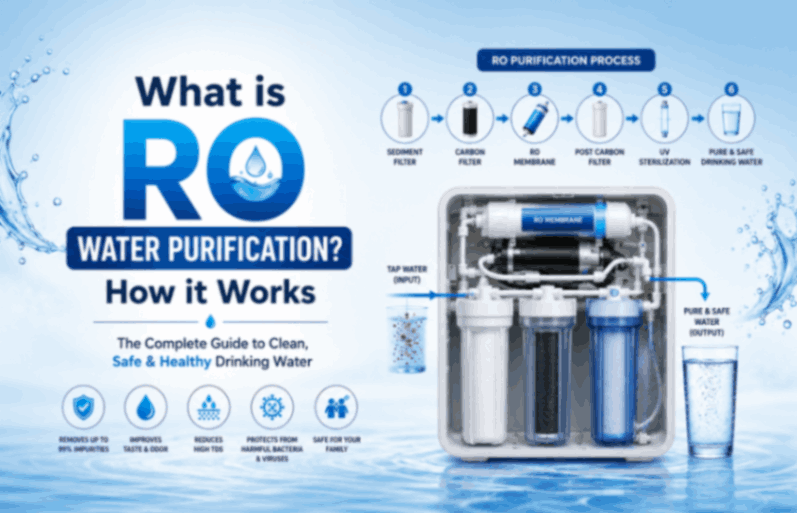
The RO purification process involves multiple stages. Let’s understand each step:
1. Pre-Filtration (Sediment Filter)
This is the first stage where large particles like dust, sand, and rust are removed.
👉 Purpose:
- Protects the RO membrane
- Improves system efficiency
2. Carbon Filtration
Water then passes through an activated carbon filter.
👉 Removes:
- Chlorine
- Bad taste and odor
- Organic impurities
This step ensures better-tasting water and protects the membrane from chemical damage.
3. RO Membrane (Main Filtration Stage)
This is the heart of the RO system.
Water is forced through a semi-permeable membrane that allows only pure water molecules to pass while blocking contaminants.
👉 Removes:
- Dissolved salts (TDS)
- Heavy metals
- Bacteria and viruses
Impurities are flushed out through a separate drain line.
4. Post-Carbon Filter
After RO filtration, water passes through another carbon filter to polish the taste.
👉 Purpose:
- Enhances taste
- Removes any remaining odor
5. UV/UF (Optional Stage)
Some advanced RO systems include UV (Ultraviolet) or UF (Ultrafiltration) purification.
👉 Benefits:
- Kills bacteria and viruses
- Adds an extra layer of safety
6. Storage Tank
Finally, purified water is stored in a tank, ready for use whenever needed.
What is TDS and Why Does It Matter?
TDS (Total Dissolved Solids) refers to the amount of dissolved substances in water.
- Low TDS: May lack essential minerals
- High TDS: Unsafe and unhealthy
RO systems help maintain balanced TDS levels, making water safe and healthy.
Types of RO Systems
Depending on your needs, you can choose from:
1. Domestic RO Systems
- Ideal for homes
- Compact and affordable
2. Commercial RO Systems
- Used in offices, schools, restaurants
- High capacity
3. Industrial RO Systems
- Used in factories and large-scale operations
Advantages of RO Water Purification
- ✔ Highly effective filtration
- ✔ Removes both physical and chemical impurities
- ✔ Improves water taste
- ✔ Easy to maintain
- ✔ Long-lasting performance
Disadvantages of RO Systems
While RO is highly effective, it has a few limitations:
- ❌ Wastes some water during filtration
- ❌ Requires regular maintenance
- ❌ Removes some essential minerals (can be fixed with mineral cartridges)
Maintenance Tips for RO Systems
To keep your RO system working efficiently:
- Change filters every 6–12 months
- Service the system regularly
- Clean the storage tank periodically
- Check for leaks or unusual noises
Regular maintenance ensures long-lasting performance and safe water.
Who Should Use RO Water Purifiers?
RO systems are ideal if:
- Your water has high TDS
- You use borewell or tanker water
- Water tastes salty or bitter
- You want maximum purification
Conclusion
RO water purification is one of the most reliable and effective ways to ensure safe drinking water. By using advanced filtration technology, RO systems remove harmful contaminants and provide clean, healthy water for everyday use.
Understanding how RO works helps you make better decisions when choosing a water purifier for your home or office.
If your water quality is poor or inconsistent, investing in an RO system is a smart and necessary step toward better health.